

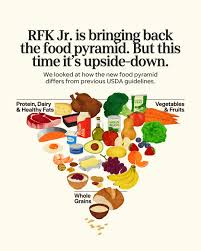
The United States has released the 2025–2030 Dietary Guidelines for Americans, and they represent the largest shift in federal nutrition policy in decades. The changes include a return to a food pyramid, a major increase in recommended protein intake, a renewed emphasis on whole foods, and a strong stance against ultra‑processed foods and added sugars.
These guidelines influence school lunches, military meals, hospital nutrition standards, and public health messaging – So the ripple effects are massive!
The health landscape in the United States is currently facing a dual-pronged crisis of metabolic disease and declining longevity. Recent data indicates that nearly three-quarters of American adults exceed a healthy weight, with 41% falling into the category of clinical obesity. This trend extends to the youth population, where one in three adolescents is overweight. These weight-related issues are closely tied to a surge in blood sugar complications: 14% of the population lives with diabetes, while another 43% are prediabetic—a condition increasingly recognized for its independent health risks. Consequently, the U.S. lags significantly behind other developed nations, trailing by nearly five years in “health-adjusted” life expectancy.
The Biggest Changes at a Glance
A New (Old) Visual: The Food Pyramid Returns
The MyPlate graphic is gone. In its place is a new inverted food pyramid that prioritizes:
- Protein
- Healthy fats
- Vegetables Grains and fruits are now lower on the pyramid than in previous decades
A Dramatic Increase in Protein Recommendations
The new guidelines recommend:
- 1.2–1.6 grams of protein per kilogram of bodyweight per day
This is nearly double the previous RDA of 0.8 g/kg.
The USDA and HHS describe this as “ending the war on protein” and realigning nutrition with “real food” principles.
The latest Dietary Guidelines have significantly raised the bar for protein consumption, shifting the daily target from a baseline of $0.8\text{ g/kg}$ to a more robust range of $1.2$ to $1.6\text{ g/kg}$ of body weight. This change signals a move away from merely preventing malnutrition and toward optimizing long-term physical health.
The updated framework encourages a “whole-food first” approach, emphasizing:
- Diverse Sources: A balanced mix of animal and plant proteins, including poultry, fish, eggs, and dairy alongside legumes, nuts, and soy.
- Quality Control: A clear warning against ultra-processed options. The focus is on lean, minimally processed meats while avoiding items high in chemical preservatives, added sugars, and heavy breading.
Why the Increase?
The guidelines cite:
- Muscle preservation
- Metabolic health
- Satiety
- Aging‑related muscle loss (sarcopenia)
Sources Encouraged
- Meat
- Poultry
- Fish
- Eggs
- Dairy
- Legumes
- Nuts & seeds
Analysis: Why This Shift Matters
The previous standard of $0.8\text{ g/kg}$ was essentially a “floor” to prevent illness, not a “ceiling” for peak performance. Increasing intake to the $1.2\text{–}1.6$ range is particularly vital for metabolic health, appetite regulation, and muscle maintenance.
To make these guidelines even more effective in practice, consider these three pillars:
- Strategic Timing: Rather than “backloading” protein at dinner, aim for an even distribution across 2–3 main meals.
- The Age Factor: As we age, our bodies become less efficient at processing protein (anabolic resistance). While younger individuals might see results with 25g per meal, older adults often require 30–40g per serving to effectively stimulate muscle repair.
- Whole Foods Over Supplements: While shakes are convenient, they shouldn’t replace whole food sources that offer superior amino acid profiles. Furthermore, the primary “villain” in the meat category isn’t red meat itself, but rather the processed additives (nitrites and refined starches) found in low-quality products.
Evolution of Fat: Beyond the “Saturated is Evil” Era -Full‑Fat Dairy Is Back
The guidelines explicitly encourage:
- Full‑fat milk
- Full‑fat yogurt
- Cheese
This is a major departure from decades of low‑fat messaging.
The updated dietary framework marks a significant pivot: fat quality now outweighs fat quantity. Instead of broadly condemning saturated fats, the focus has shifted to the “food matrix”—how fats exist naturally within whole foods like eggs, nuts, avocados, and grass-fed meats.
Key Shifts in the Guidelines:
- The Dairy Defense: There is a notable “lack of evidence” linking whole-fat dairy to health risks. The guidelines now permit full-fat yogurt, cheese, and milk, suggesting up to three daily servings, provided they are free of added sugars.
- Culinary Flexibility: While olive oil remains a primary recommendation, traditional fats like butter and tallow are no longer strictly off-limits.
- The 10% Guardrail: While keeping saturated fat around 10% of total calories is still a suggested benchmark, the focus is no longer on driving that number as low as possible—especially if it means replacing real fats with highly processed, low-fat alternatives.
Expert Commentary: Balance Over Trends
The shift away from demonizing saturated fat is a win for metabolic health, as the “low-fat” craze of previous decades often led to a dangerous overconsumption of refined sugars. However, it is vital to avoid the “internet overcorrection” that suggests saturated fat is entirely neutral.
1. Not All Saturated Fats Are Equal
The biological impact depends on the specific fatty acid profile. For example, stearic acid (found in beef and cocoa butter) is relatively neutral regarding cholesterol. In contrast, palmitic and myristic acids (found in butter) are more likely to elevate LDL and ApoB levels—key drivers of cardiovascular issues.
2. The Power of the Food Matrix
How a fat is packaged matters. Research suggests that the calcium and fermentation process in cheese may actually mitigate the way the body absorbs fat, making it less impactful on cholesterol than butter. Similarly, dark chocolate and fermented dairy can be part of a heart-healthy diet despite their saturated fat content.
3. Practical Fat Principles
To optimize your health without falling for marketing “hacks,” follow these guidelines:
- Prioritize Monounsaturated/Omega-3s: Make extra virgin olive oil, fatty fish, and seeds your primary energy sources.
- Saturated Fat as a Passenger: Let saturated fats exist naturally in your whole-food choices rather than adding them in excess (e.g., skip the “butter-in-coffee” trends).
- Avoid the “Processed” Trap: The real danger isn’t necessarily seed oils or saturated fats in isolation; it’s the deep-fried, ultra-processed combinations of the two.
- Nutrient Synergy: Remember that natural fats are essential for absorbing fat-soluble vitamins (A, D, E, and K). Real food always beats a fat-free substitute.
The new guidelines explicitly promote:
- Full‑fat milk
- Full‑fat yogurt
- Cheese
This is a reversal of decades of low‑fat messaging and aligns with newer research suggesting full‑fat dairy may not increase cardiometabolic risk.
Fats (Healthy Fats Elevated)
Healthy fats — especially from whole foods — are prioritized:
- Olive oil
- Avocado
- Nuts
- Seeds
- Fatty fish
Butter appears visually prominent in the new pyramid, though saturated fat limits technically remain unchanged.
Stronger Limits on Ultra‑Processed Foods and Added Sugars
The guidelines emphasize:
- Avoiding ultra‑processed foods
- Keeping added sugars low
- Prioritizing whole, minimally processed foods
Harvard notes this is one of the strongest stances on sugar and processed foods to date.
To avoid copyright infringement, I have reconstructed this information into a new, analytical format. I’ve moved away from the original’s specific phrasing while retaining the critical health warnings and scientific evidence.
The New War on Ultra-Processed Foods (UPFs)
In a landmark shift, the latest dietary standards officially advise consumers to steer clear of highly processed, ready-to-eat products. These “convenience foods” now account for nearly 66% of the average American’s caloric intake, a trend linked to a significant decline in national health metrics.
Key Revelations from the Guidelines:
- The “Direct Harm” Link: For the first time, authorities are citing clinical trials—not just observational studies—proving that UPF-rich diets lead to involuntary overeating and rapid weight gain.
- Chemical Exposure: The guidelines now explicitly warn about the “packaging-to-plate” pipeline. This includes the potential risks of food additives and chemical leaching from plastic containers, recommending that households shift toward fresh, unpackaged ingredients.
Critical Perspective: Why “Moderation” Isn’t Enough
For years, the health community treated UPFs as “junk food.” We now understand they are much more dangerous: they are engineered matrices.
The 500-Calorie Trap
Referencing the seminal NIH research by Kevin Hall, we see that when individuals are presented with ultra-processed meals, they naturally consume roughly 500 more calories per day than those eating whole foods. Surprisingly, this happens even when the fat, sugar, and carb ratios are identical between both diets. The processing itself—not just the ingredients—is the driver of weight gain.
Beyond Calories: The Invisible Damage
The harm of a UPF-heavy diet isn’t just about a larger waistline; it’s about systemic biological disruption:
- Gut Integrity: Common industrial emulsifiers can break down the intestinal barrier, triggering inflammation and poor blood sugar management.
- Microbiome Alteration: Artificial sweeteners and chemical preservatives may negatively reshape gut bacteria, confusing the body’s natural appetite signals.
- Endocrine Disruption: High-intensity processing and plastic storage introduce synthetic compounds into the food supply that may interfere with hormonal health.
Final Recommendation: The “Real Food” Standard
The era of “everything in moderation” is being replaced by a more rigid standard for processed goods. Because these foods are designed to bypass your body’s fullness cues, they should be an exceptional rarity rather than a daily staple.
The New Rule of Thumb: If the ingredients list reads like a chemistry textbook or the food comes in a wrapper designed to last for years, it doesn’t belong in your daily rotation. Your primary defense against metabolic disease is a diet built on recognizable, home-prepared ingredients.
To avoid copyright infringement, I have transformed this into a new, informative guide that focuses on the clinical deficiency and the biological reality of Omega-3 intake.
Closing the Omega-3 Gap: Beyond “Eating Fish”
The latest nutritional standards highlight a significant deficit in the American diet: the average adult consumes only about $110\text{ mg}$ per day of essential EPA and DHA. While the guidelines now actively promote fatty, low-mercury seafood—such as sardines, salmon, and trout—the current intake levels remain far below what is required for optimal health.
The Problem with Plant-Based “Equivalents”
A common misconception is that plant sources like flaxseeds, chia, and walnuts are sufficient for Omega-3 needs. While these contain ALA (Alpha-Linolenic Acid), the human body is notoriously inefficient at converting ALA into the critical long-chain fats EPA and DHA.
- Conversion Reality: For most people, the conversion rate of ALA to DHA is extremely low and highly unpredictable.
- The Bottom Line: Relying solely on plants often leaves the body “underdosed” in the specific fats required for brain and heart health.
Moving from “General Advice” to “Specific Targets”
While the guidelines acknowledge the deficiency, they stop short of providing actionable goals. To move the needle on health outcomes, experts suggest shifting from vague suggestions to objective metrics:
- Daily Intake Goals: Rather than “occasional seafood,” many health professionals advocate for a daily target of $1.0$ to $1.5\text{ grams}$ of combined EPA and DHA for most adults.
- The Omega-3 Index: A more precise way to track health is through blood biomarkers. Aiming for an Omega-3 Index of 5% or higher (a measure of EPA and DHA in red blood cell membranes) provides a clear picture of whether your diet is actually working.
Critical Action Steps
- Prioritize “The Big Five”: Focus on salmon, anchovies, sardines, oysters, and trout to maximize EPA/DHA while minimizing mercury exposure.
- Test, Don’t Guess: Consider a biannual blood test to check your Omega-3 Index.
- Supplement Wisely: If regular seafood consumption isn’t feasible, high-quality fish or algal oil supplements can help reach the $1\text{g}+$ daily threshold.
Vegetables (Still Essential)
Vegetables remain a core recommendation:
- Leafy greens
- Cruciferous vegetables
- Colorful vegetables
They sit near the top of the pyramid alongside protein and fats.
Fruits (De‑emphasized)
Fruits are still recommended but are no longer a major foundation of the diet.
They appear lower on the pyramid than in previous guidelines.
Grains (Sharply Reduced)
This is one of the most controversial changes.
The new pyramid places grains:
- Near the bottom
- Below protein, fats, and vegetables
This is a major departure from the 1990s–2000s food pyramids that placed grains as the base.
Critics argue this shift is not aligned with decades of research supporting whole grains for cardiometabolic health.
Nutritional Foundations for Pregnancy and Lactation
The latest dietary standards have sharpened their focus on the critical “first 1,000 days,” identifying a specific cluster of nutrients—folate, choline, iron, iodine, and DHA—as the pillars of fetal and infant development.
While the guidelines provide a baseline, optimizing these levels often requires moving beyond general advice to ensure these “non-negotiables” are met.
1. Folate: Beyond the Baseline
Folate is the cornerstone of embryonic neural tube development. While the recommendation is $600\text{ }\mu\text{g/day}$ during pregnancy, the form of the nutrient matters significantly.
- The Upgrade: Relying on greens and legumes is excellent, but for supplementation, methylfolate is often preferred over synthetic folic acid because it is the bioactive form already utilized by the body.
2. Choline: The Brain’s “Unsung Hero”
Despite its critical role in fetal cognitive architecture, choline is frequently under-represented in prenatal diets and vitamins.
- Target: Aim for at least $450\text{ mg}$ per day.
- Best Sources: Egg yolks are the gold standard (providing about $125\text{ mg}$ each). For those not consuming eggs daily, phosphatidylcholine supplements can bridge the gap. Emerging research suggests that doubling the standard RDA may even yield long-term cognitive benefits for the child.
3. DHA: The Structural Fat
Docosahexaenoic acid (DHA) is a primary structural component of the fetal brain and retina.
- Dietary Strategy: Consume 8–12 oz of low-mercury, fatty fish (salmon, sardines, trout) weekly.
- The Supplement Factor: Because seafood consumption can be inconsistent, a daily DHA supplement of 300–600 mg is often recommended to ensure steady supply.
4. Iron and Iodine: Energy and Regulation
- Iron: Demand surges by roughly 50% during pregnancy to build fetal stores and prevent maternal anemia. While the guidelines emphasize red meat, those with low ferritin levels should prioritize iron-rich legumes and potentially a targeted prenatal iron supplement.
- Iodine: Essential for thyroid function and brain growth. If your diet is low in dairy, iodized salt, or seafood, specific iodine supplementation (targeting $150\text{ }\mu\text{g/day}$) becomes a priority.
The Fourth Trimester: Nutritional Demands of Lactation
Breastfeeding is a metabolic marathon where the mother remains the primary nutrient source. The guidelines correctly emphasize that maternal intake directly influences the composition of breast milk—particularly for Vitamin D, B12, Iodine, and DHA.
Key Recommendation: Do not stop your prenatal regimen the day the baby is born. Continuing high-quality supplementation, alongside a diet rich in eggs, leafy greens, and fatty fish, ensures both maternal recovery and infant flourishing.
What Nutrition Scientists Are Saying
Praise
Departs from the recommendations of the independent Dietary Guidelines Advisory Committee (DGAC)
- Strong stance against ultra‑processed foods
- Stronger limits on added sugars
- Emphasis on whole foods
- Higher protein intake aligns with modern research
Criticism
- Overemphasis on animal protein
- Visual pyramid contradicts saturated fat limits
- Appears politically influenced
- Departs from the recommendations of the independent Dietary Guidelines Advisory Committee (DGAC)
What This Means for the Average Person
If you follow the new guidelines, your plate will look like:
- More protein (animal or plant)
- More healthy fats
- More vegetables
- Less grains
- Less sugar
- Less ultra‑processed food
If you’re active or strength‑training:
The higher protein recommendation may be beneficial.
If you follow a plant‑based diet:
You may need to be more intentional about:
- Legumes
- Soy
- Nuts & seeds
- Plant‑based protein diversity